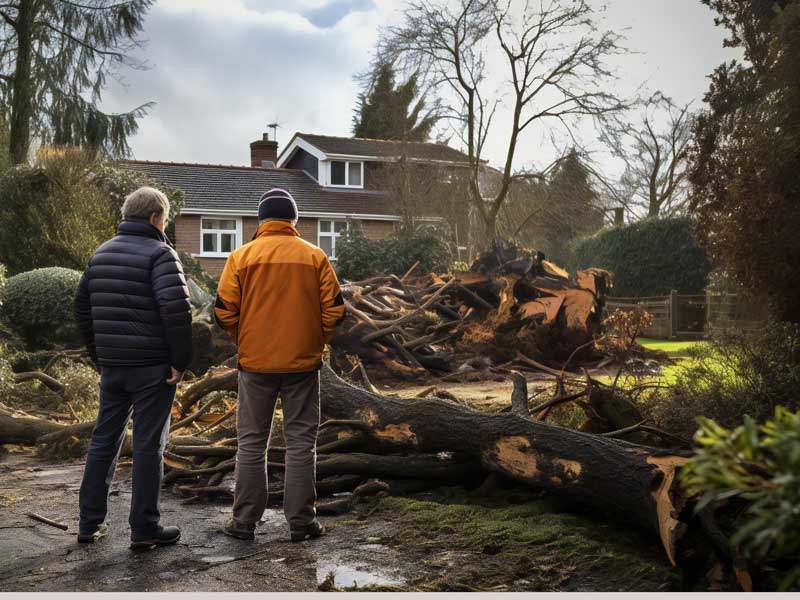
There used to be a fairly predictable pattern.
A few fence panels would come down after a particularly bad winter storm. Homeowners would replace the damaged section, maybe straighten a leaning post, and that would be the end of it for another few years.
That isn’t what I’m seeing anymore.
Storm damage has become one of the biggest reasons people replace entire runs of fencing rather than carrying out isolated repairs. Across Leeds and West Yorkshire, stronger winds combined with saturated ground are exposing weaknesses that have often been developing quietly for years.
It’s not always the storm that’s the problem.
More often, the storm simply reveals it.
Many homeowners start looking for fence repair near me after a spell of bad weather, convinced the wind has caused the damage. In reality, the posts may have been moving underground for several winters before the fence finally gave way.
That’s an important difference because preventing storm damage starts long before the weather forecast turns nasty.
Wind Rarely Breaks A Well-Built Fence
People often blame the weather.
Sometimes they should blame the installation.
That might sound harsh, but it’s true.
I’ve inspected plenty of fences that supposedly “blew over in the storm” only to find the concrete around the posts barely extended below ground level. Others had timber posts sitting in permanently wet clay with no chance of lasting long term.
A properly installed fence should cope with typical British weather.
Will extreme storms occasionally cause damage?
Of course.
But average winter winds shouldn’t flatten a boundary that has been built correctly.
One thing I see often on local jobs is posts that have gradually loosened over several years. The homeowner never notices because the movement is tiny.
Then a named storm arrives.
Suddenly the entire fence appears to fail overnight.
It didn’t.
It simply reached the point where the movement became impossible to ignore.
Saturated Ground Is Often The Real Culprit
If you want to understand storm damage, don’t just look upwards.
Look down.
Leeds has plenty of heavy clay soils that hold water for long periods during autumn and winter. Once that ground becomes saturated, it loses much of the support it normally provides around fence posts.
That’s when problems begin.
The wind doesn’t need to snap the timber.
It only needs enough force to move the post slightly inside softened ground.
Once that movement starts, every gust makes it worse.
I’ve dug out fence posts that looked perfectly sound above ground but had started decaying several inches below the surface where moisture never really disappeared.
Homeowners couldn’t understand why the fence had collapsed.
The answer had been hidden underground for years.
Modern Housing Estates Create New Challenges
Storm damage seems particularly common on newer developments.
There are several reasons.
Many estates have very few mature trees or established hedges, meaning fencing takes the full force of crosswinds across open spaces.
Gardens also tend to be smaller.
Properties sit closer together.
Wind funnels between buildings in ways older streets rarely experience.
Combine that with lightweight boundary fencing installed during fast-paced construction programmes and you have the perfect recipe for problems later.
I’ve replaced countless sections of fencing on estates that are barely ten years old.
That shouldn’t really be happening.
Good fence installation ought to last much longer than that.
Fence Panels Aren’t Always The Weak Point
People naturally focus on the panels because that’s the part they can see.
Quite often, they’re the strongest part of the fence.
The real weakness is usually somewhere else.
Common issues include:
- insufficient post depth
- poor concrete foundations
- inadequate drainage
- loose fixings
- rotting arris rails
- cracked gravel boards
- timber constantly touching soil
Any one of those can reduce the life of an otherwise decent fence.
Several together almost guarantee future repairs.
From years on site, I’d much rather see slightly older fence panels supported by strong posts than brand-new panels attached to unstable foundations.
Good groundwork wins every time.
Stronger Doesn’t Always Mean Better
One reaction to recent storms has been installing heavier fencing.
Sometimes that’s sensible.
Sometimes it creates new problems.
Heavier panels place greater loads on the posts, particularly during strong winds. If the foundations haven’t been upgraded as well, all you’ve done is increase the forces acting on the weakest part of the fence.
It’s a bit like fitting larger wheels to a car with worn suspension.
You’ve changed one part without thinking about the whole system.
Every fencing project should be considered as one complete structure.
Posts.
Rails.
Panels.
Fixings.
Ground conditions.
They all work together.
Composite Fencing Continues To Divide Opinion
Composite fencing attracts plenty of interest after storm damage because homeowners assume it must automatically be stronger than timber.
That’s not always the case.
Composite behaves differently.
It resists rot well and generally requires less maintenance, but installation becomes even more important.
Expansion gaps need to be correct.
Posts need accurate spacing.
Everything has to remain level.
I’ve seen expensive composite fencing develop problems simply because basic installation principles were ignored.
The composite fencing cost also means mistakes become much more expensive to correct later.
Choosing the right material matters.
Installing it properly matters even more.
Small Repairs Prevent Big Bills
One of the biggest mistakes homeowners make is waiting.
A slightly loose fence rarely repairs itself.
If anything, it usually deteriorates surprisingly quickly once movement begins.
Look out for:
- gates beginning to catch
- posts that wobble by hand
- fence lines no longer appearing straight
- screws working loose
- cracked rails
- water pooling around post bases
Those warning signs often appear months before failure.
Unfortunately, many people don’t start searching for fencing contractor near me until panels have already collapsed across the garden.
Early intervention nearly always costs less.
Weather Is Changing Maintenance Habits
Something else has shifted recently.
Homeowners are becoming more proactive.
Instead of waiting until spring, more people now arrange inspections during early autumn.
It makes sense.
Ground conditions are usually better.
Contractors aren’t dealing with emergency call-outs after every storm.
Minor repairs can be completed before winter arrives.
I’ve always thought autumn is one of the best times to assess fencing.
The leaves begin falling.
Visibility improves.
Problems become easier to spot before they turn into expensive replacements.
Timber Still Performs Exceptionally Well
Storm damage sometimes gives timber an unfair reputation.
Quality timber fencing remains one of the best options for British gardens.
The key is understanding where it works best.
Properly pressure-treated timber, installed with adequate drainage and sensible clearances, can last for many years.
The problems usually begin when shortcuts are taken.
Posts installed too shallow.
Concrete mixed too wet.
Flowerbeds piled against gravel boards.
Drainage ignored.
None of those issues are caused by the timber itself.
They’re caused by poor installation or poor maintenance.
I’ve removed twenty-year-old timber fencing that was still remarkably solid.
I’ve also replaced five-year-old fencing that should never have failed so quickly.
The difference was almost always below ground.
Garden Design Is Influencing Fence Choices
Storm resilience isn’t the only consideration anymore.
People want attractive gardens as well.
That has encouraged more homeowners to combine fencing with hedging, ornamental planting and sheltered borders that naturally reduce wind pressure.
Done well, planting can help.
Shrubs soften gusts before they reach the fence.
Well-positioned trees create natural shelter.
Climbing plants break up large exposed sections without placing excessive weight on the structure.
The balance matters.
I’ve seen beautiful gardens where the fencing almost disappears behind carefully planned planting.
I’ve also seen heavy ivy pull perfectly good fence panels apart.
Nature helps when it’s managed.
It becomes another problem when it isn’t.
Experience Makes A Difference
Storm damage isn’t always avoidable.
Britain’s weather will always test outdoor structures.
What experience teaches you is where those weak points usually develop first.
It teaches you which gardens need deeper posts.
Which soil stays wet longest.
Which corners catch every gust from the west.
Which gates will eventually begin dropping unless they’re supported correctly.
Those aren’t things you learn from a catalogue.
You learn them by digging thousands of post holes across every season and returning years later to see how your work has performed.
That’s why so many homeowners searching for fencing contractors now ask more questions than they used to.
Not just about the panels.
About post depth.
Drainage.
Ground conditions.
Concrete.
Maintenance.
They’re the conversations worth having.
Because the strongest fences aren’t the ones that survive the first storm.
They’re the ones that quietly stand through ten winters without anybody giving them a second thought.

Leave a Reply